Hosted tests, workflows and secrets
This page explains how Cloudflare-native Golf runs tests and workflows, how secrets reach a job, and where container images come from. It is for reviewers who read job results and administrators who configure them.
A job runs tests or another approved task against a specific commit. Golf keeps its status, logs and report with that commit, so reviewers can see what actually ran.
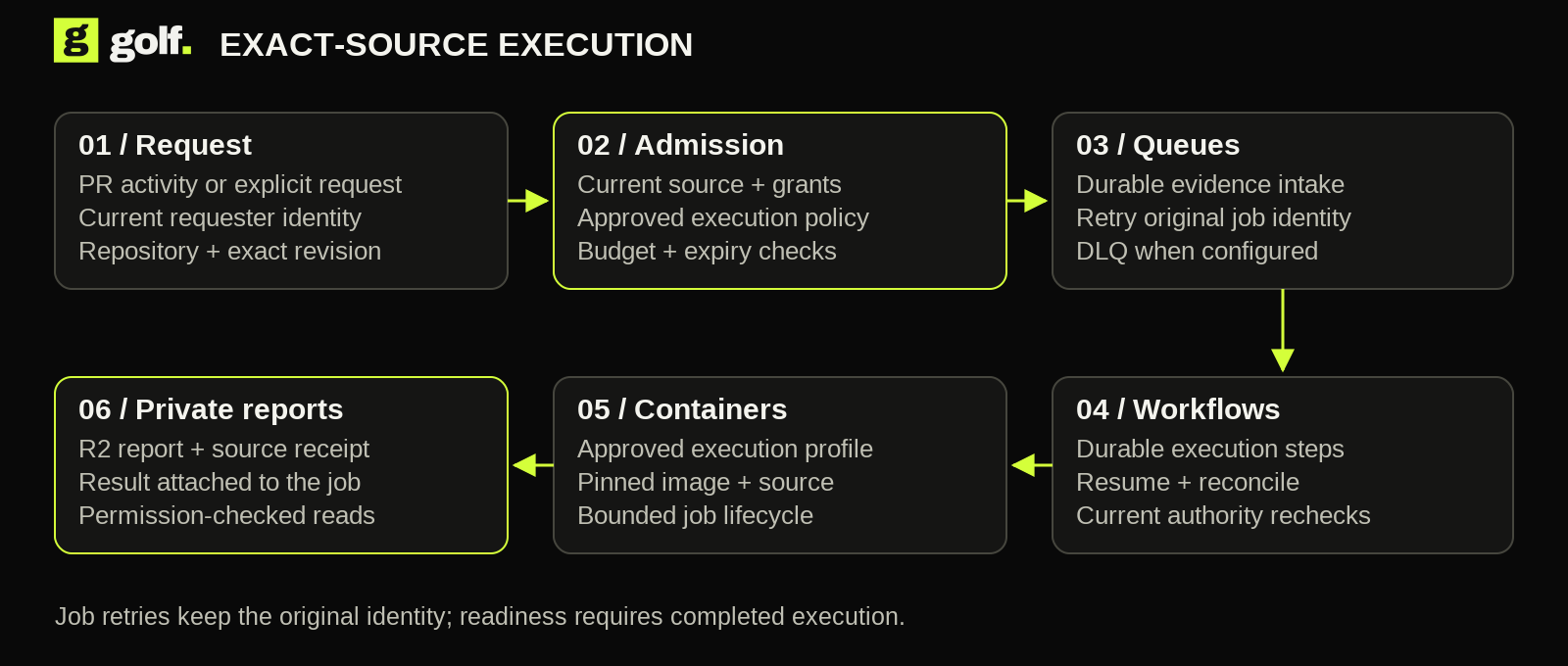
Editable Mermaid source · All architecture diagrams.
Managed container jobs
| Service | Role |
|---|---|
| Queues | Holds work until it can start |
| Workflows | Saves progress between stages |
| Containers | Runs the approved command |
Golf checks permissions at the documented steps; a changed commit, revoked access or expired job can stop further work.
Supported managed jobs
The managed pull request path supports an approved Python module or one operator-approved Actions shell workflow. Its networking is restricted.
| Limit | Value |
|---|---|
| Files workflow settings can inspect | Up to 20 default-branch files, 64 KiB each. Inspecting a file does not start it. |
| Runs listed on the reviewed Actions page | The latest 50 stored pull request runs |
Disabling new repository runs does not cancel jobs already accepted, and does not control agent proposals. Broader workflow syntax and triggers require separate support.
Pipelines on your own runners
A newer native pipeline path connects stock Forgejo Runner and GitLab Runner. Actions workflows can run on push, supported pull request events or manual dispatch. Supported GitLab pipelines include stages, parallel jobs, services, artifacts, cache and manual jobs. Environment approvals can hold a deployment before its secrets are released.
October 14 hosted tests ran selected unchanged upstream workflows, saved artifacts and deployed into a test Kubernetes cluster after approval. This does not establish compatibility with every workflow. Scheduled triggers, reusable workflows and some upstream actions remain unsupported.
The upstream actions/upload-artifact@v4 refuses non-GitHub servers, so use the supported Forgejo fork.
On Cloudflare, turn this path on with Alchemy: migrate, then enable-pipelines, then deploy (see Cloudflare setup). Then register runners under Settings > Runners. Runner setup is separate from the core Helm chart. Inspect each job’s status and logs; missing runner labels can leave jobs waiting. See current status for the specific tests and gaps.
Secrets for managed jobs
Repository secrets and variables are encrypted in D1 with a key from Secrets Store. Administrators can manage their names and settings; the inventory never returns saved secret values.
In this managed path:
- Only an administrator-approved commit and branch of the allowed pull request workflow receives secrets.
- Approval lasts at most 24 hours.
- Agent jobs do not receive secrets.
Other runner and environment paths have their own support and permission rules.
A hosted test confirmed a secret reached its step and was masked in stored output.
Encoded or transformed values may still appear, so jobs must keep secrets out of source and arbitrary output.
Rotation and additional outbound network access remain unfinished.
Container images
Cloudflare’s managed registry stores approved runner images and images published by authorized jobs. Golf records their content hashes to identify exact versions. Provider credentials remain in trusted server code. Broader scanning, trust and retention policies still need work.
See the product test ledger and managed registry guide.